How to Choose Ski Boots
Selecting the right pair of ski boots is essential for comfort, control, and performance on the slopes. Here's our guide to help you understand the key features and how to find the perfect fit.
Understanding Ski Boot Fit
Ski boots come in various designs to accommodate different foot shapes and skiing styles. All ski boots are comprised of the following components:
Shell: The hard outer casing that provides support and protection.
Liner: The soft inner boot that offers cushioning, warmth, and stability where it matters.
Closure System: Buckles and/or BOA cable systems used to secure and fit the boot to your foot.
Heel: The base of the boot, which may include features such as GripWalk or touring binding compatibility.
Explore all K2 ski boots to compare fit, flex, closure systems, and intended use.
Ski Boot Flex: Finding Your Comfort Zone
The flex index of a ski boot indicates its stiffness. A higher number means a stiffer boot, which translates to more power transfer but may be less forgiving. Here's a general guide:
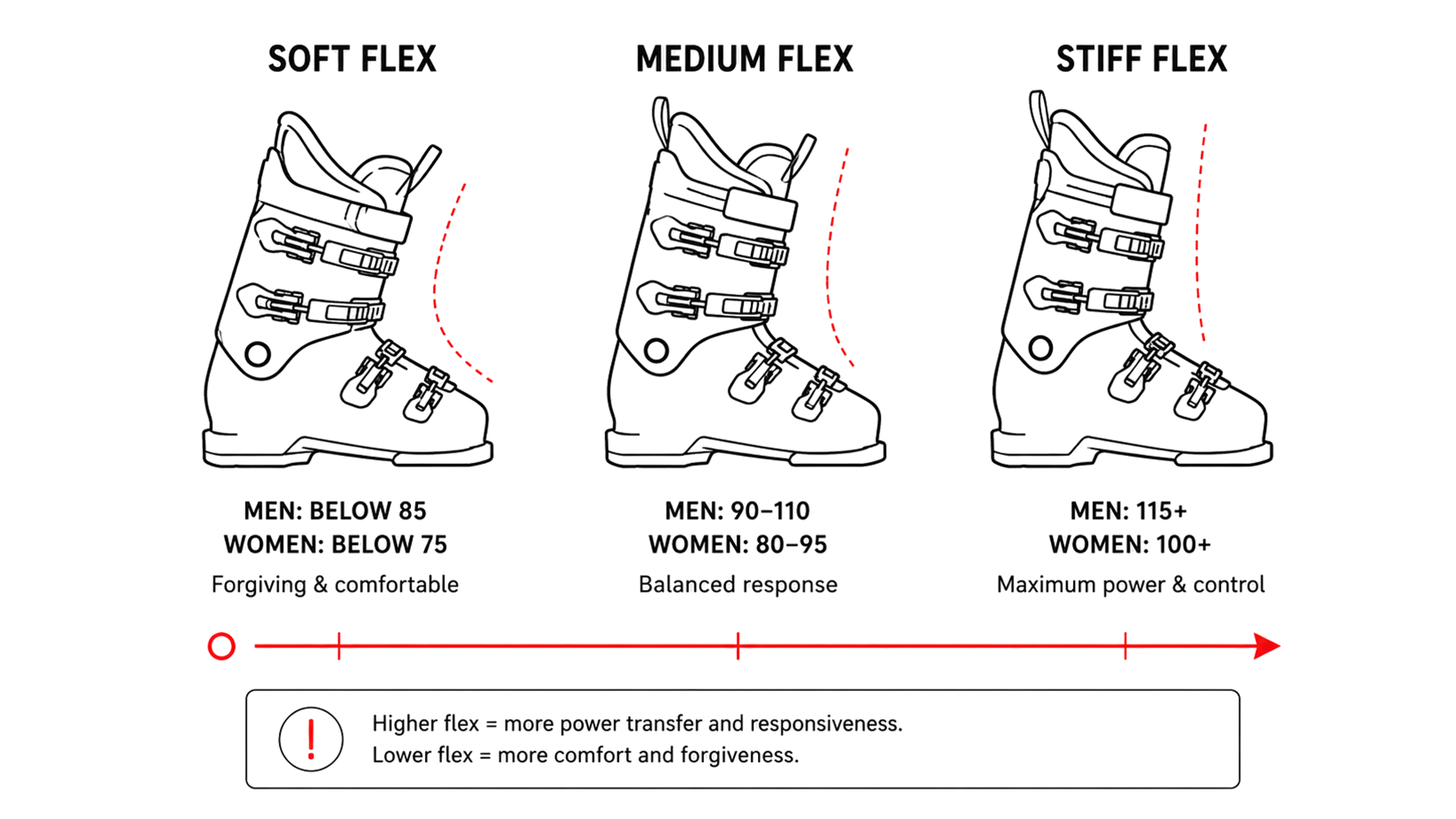
Soft Flex: Flex index below 85 for men and 75 for women. Ideal for beginners or those skiing leisurely on groomed runs.
Medium Flex: Flex index between 90–110 for men and 80–95 for women. Suitable for intermediate skiers seeking improved responsiveness.
Stiff Flex: Flex index above 115 for men and 100 for women. Designed for advanced skiers tackling steep terrain and high speeds.
Ski Boot Sizing: Understanding Mondopoint
Ski boots often use the Mondopoint sizing system, which measures the length of your foot in millimeters. For example, a size 26.5 corresponds to a foot length of 265 mm.
Don’t know your size? Start here: stand on a piece of paper, mark the end of your longest toe and the back of your heel, then measure the distance in centimeters. That number is your foot length — and it maps directly to Mondopoint. Use the table below to find your size across all systems.
| Foot Length / Mondopoint (cm) | EU | UK | US Men’s | US Women’s | JP |
|---|---|---|---|---|---|
| 22.5 | 35.5 | 3 | 4.5 | 5.5 | 225 |
| 23.0 | 36 | 3.5 | 5 | 6 | 230 |
| 23.5 | 37 | 4 | 5.5 | 6.5 | 235 |
| 24.0 | 38 | 5 | 6 | 7 | 240 |
| 24.5 | 38.5 | 5.5 | 6.5 | 7.5 | 245 |
| 25.0 | 39 | 6 | 7 | 8 | 250 |
| 25.5 | 40 | 6.5 | 7.5 | 8.5 | 255 |
| 26.0 | 40.5 | 7 | 8 | 9 | 260 |
| 26.5 | 41.5 | 7.5 | 8.5 | 9.5 | 265 |
| 27.0 | 42 | 8 | 9 | 10 | 270 |
| 27.5 | 43 | 8.5 | 9.5 | 10.5 | 275 |
| 28.0 | 44 | 9.5 | 10.5 | 11.5 | 280 |
For a more precise fit, consider the last width, which refers to the width of the boot at the ball of the foot.
GripWalk Compatibility
If you bought skis within the past few years, there’s a high chance they come with GripWalk bindings, as the GripWalk system was established in 2017 and has since become the industry standard. GripWalk-compatible bindings are marked with the GripWalk logo in the toe area — bindings with this logo are GripWalk compatible without height adjustment.
Standard alpine shoes, ISO 5355, are compatible with GripWalk bindings. Thus, both standard alpine soles, ISO 5355, and GripWalk soles fit on GripWalk bindings. Please note that shoes with soles that comply with the touring norm may not be used in either GripWalk or standard alpine bindings.
Additional Features to Consider
Forward Lean: The angle at which your boot positions your ankle. A more aggressive forward lean can improve control but may be less comfortable for some skiers. Some models allow for this angle to be adjusted.
Ramp Angle: The angle between your foot and the ski. Adjusting the ramp angle can affect your skiing posture and balance.
Cuff Adjustments: Some boots allow you to adjust the cuff to accommodate different calf shapes and sizes.
Touring Compatibility: If you plan to tackle the backcountry and use your boots with touring-specific bindings, most touring bindings require compatibility with a pin system. You will also need to look for a boot with walk mode.
Ready to Hit the Slopes?
Choosing the right ski boots is a crucial step in enhancing your skiing experience. By understanding fit, flex, sizing, and customization options, you can find boots that provide comfort, control, and confidence on the mountain. Happy skiing!
Start with all K2 ski boots, or explore BOA ski boots for dialed-in micro-adjustability.
Related guides